Welcome to Our Company


 Send Inquiry
Two Head Wide Belt Sanding Machine
MOQ : 1 Box
Two Head Wide Belt Sanding Machine Specification
- Type
- Wide Belt Sanding Machine
- Material
- Heavy Duty Steel
- Capacity
- 800-1200 mm working width
- Computerized
- No
- Automatic Grade
- Automatic
- Power
- 15+11 kW (Main Motors)
- Voltage
- 380V / 50Hz
- Filling Heads
- 2 (Sanding Heads)
- Air Pressure
- 0.6 MPa
- Weight
- 3000 kg (Approx.)
- Dimension (L*W*H)
- 2300 x 2200 x 2200 mm
- Color
- Standard White & Blue
- Display Type
- Digital Thickness Controller
- Max. Working Thickness
- 100 mm
- Application
- Calibration & Fine Sanding of Wood Panels
- Min. Working Length
- 500 mm
- Feeding Table Height
- 900 mm
- Safety Features
- Overload & Emergency Stop System
- Conveyor Speed
- 5-25 m/min (Adjustable)
- Sanding Belt Size
- 2200 x 1100 mm
- Dust Collection Port Diameter
- 150 mm x 3
- Noise Level
- <80 dB
Two Head Wide Belt Sanding Machine Trade Information
- Minimum Order Quantity
- 1 Box
- Supply Ability
- 100 Boxes Per Month
- Delivery Time
- 1 Months
Two Head Wide Belt Sanding Machine About

Specifications:
| MODEL | KI-1300-RP-RP-B-B |
| Width of Panel | 40-1300mm |
| Thickness of Sanded Panel | 3~160mm |
| Speed of Abrasive Belt on 1st Unit | 18 m/s |
| Speed of Abrasive Belt on 2nd Unit | 12 m/s |
| Speed of Conveyor Belt / Feed Speed | 6~30 m/min |
| Size of Abrasive Belt | 1330x2620 mm |
| Motor Required | 1st Head 20 / 25 H.P. |
| | 2nd Head 20 / 25 H.P |
| Brushing Unit | 7.5 H.P |
| Brushing Unit | 7.5 H.P |
| Feed Motor | 5 H.P. |
| Hoist Motor | 0.5 H.P. |
| Working Pressure | 0.55 Mpa |
| Consumption of Compressed Air | 1.56m3/ h |
| Volume of sucked air | 7896m3/h |
| Average Speed of Sucked Air | 25~30 m/s |
| Overall Dimensions (LxWxH) | 2600x3400x2750 mm |
| Weight | 4500 Kgs. |
All specifications, dimensions & design characteristic are subject to change without prior notice.
Advanced Sanding Performance
Designed for professional woodworkers and industries, this wide belt sanding machine combines high efficiency with great flexibility. Its dual sanding heads enable both calibration and fine sanding processes, delivering superior surface smoothness. The adjustable conveyor speed makes it suitable for different wood types and finishes, while the large working capacity accommodates panels commonly used in furniture and cabinetry.
Safety and Ease of Use
With a focus on operator protection, the machine integrates both overload and emergency stop systems. The digital thickness controller allows precise adjustments, minimizing errors and facilitating a streamlined workflow. Maintenance is simple due to its sturdy build and accessible components, making it ideal for regular, high-volume use.
Dust Collection and Workplace Environment
Maintaining a clean and safe work area is vital. The machine is equipped with three 150 mm diameter dust ports, efficiently capturing sanding residues. Combined with a noise level of under 80 dB, it promotes healthier conditions, reducing risks associated with wood dust inhalation while ensuring minimal disruption in shared workspace environments.
FAQs of Two Head Wide Belt Sanding Machine:
Q: How does the Two Head Wide Belt Sanding Machine operate for calibration and fine sanding?
A: The machine employs dual sanding heads and an adjustable conveyor speed (525 m/min). It first calibrates wood panels to the desired thickness and then uses fine sanding for a smooth finish. The digital thickness controller allows precise adjustments throughout the process.Q: What types of wood panels are suitable for this sanding machine?
A: This machine is designed for panels with a working width of 8001200 mm, thickness up to 100 mm, and minimum length of 500 mm. It is ideal for a range of applications such as furniture components, doors, and cabinetry.Q: When should I use the overload and emergency stop systems?
A: The overload and emergency stop features should be activated if the machine detects excessive strain, overheating, or any immediate safety risks during operation. These systems protect both operators and the equipment from accidents or damage.Q: Where is the machine manufactured or supplied from?
A: This wide belt sanding machine is available from exporters, importers, manufacturers, suppliers, and traders based in India. It conforms to Indian industrial standards and comes in standard white and blue coloring.Q: What is the maintenance process for this sanding machine?
A: Routine maintenance includes checking motor performance, ensuring the sanding belts are properly aligned and replaced when needed, emptying dust collection units, and inspecting safety features. Regular servicing maximizes lifetime and safe operation.Q: How does the dust collection system benefit users during sanding operations?
A: The three 150 mm ports efficiently extract sanding debris, minimizing airborne dust. This not only keeps the workspace cleaner but also improves air quality and operator health, while reducing maintenance caused by dust accumulation.Q: What are the advantages of the digital thickness controller on this machine?
A: The digital thickness controller supports precise panel adjustment, reducing manual measurement errors and increasing accuracy. This results in consistent sanding outcomes, greater productivity, and less material wastage.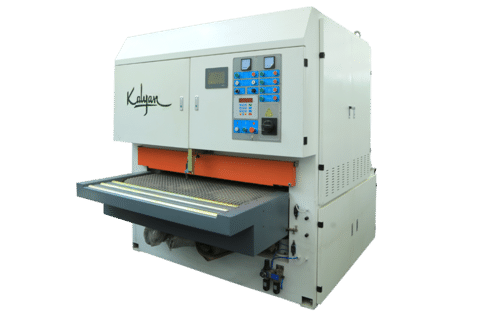
Tell us about your requirement

Price:
Quantity
Select Unit
- 50
- 100
- 200
- 250
- 500
- 1000+
Additional detail
Mobile number
Email

More Products in Plywood Making Machines Category
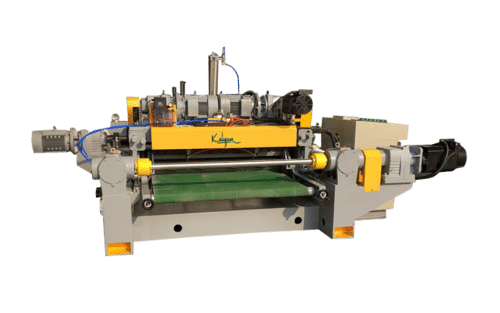
SPINDLELESS ROTARY PEELING MACHINE (1300-HBH / DD)
Minimum Order Quantity : 1 Box
Material : Heavy Duty Mild Steel
Dimension (L*W*H) : 4500 x 1800 x 1500 mm
Computerized : Yes
Type : Spindleless Rotary Peeling Machine
Automatic Grade : Automatic
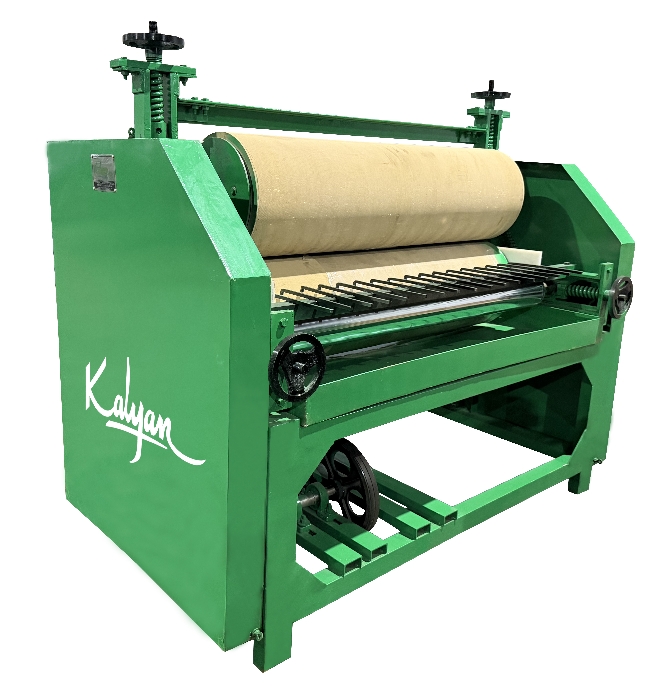
Four Roller Glue Spreader Machine
Minimum Order Quantity : 1 Piece
Material : Mild Steel Body, Rubber Rollers
Dimension (L*W*H) : 2400 mm x 950 mm x 1450 mm
Computerized : No
Type : Four Roller Glue Spreader Machine
Automatic Grade : SemiAutomatic
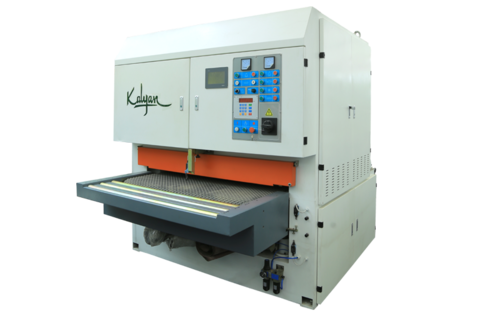
THREE HEAD WIDE BELT SANDING MACHINE
Material : Industrialgrade steel
Dimension (L*W*H) : 2620mm x 1650mm x 2100mm
Computerized : Yes
Type : Wide Belt Sander
Automatic Grade : Automatic
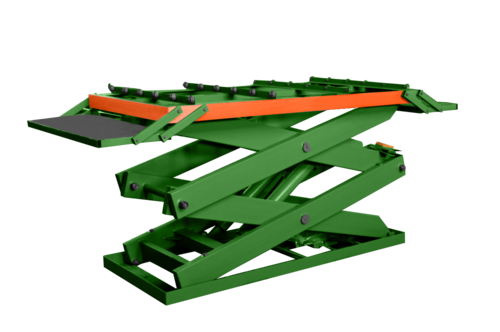
Hydraulic Scissor Lift (12D/L)
Minimum Order Quantity : 1 Box
Material : Mild Steel
Dimension (L*W*H) : 3000 x 1200 x 1000 mm
Computerized : No
Type : Hydraulic Scissor Lift (12D/L)

KALYAN INDUSTRIES
GST : 06AABFK0510G1Z2
GST : 06AABFK0510G1Z2

- Opposite Punjab & Sind Bank, Jagadhri Road,Yamunanagar - 135001, Haryana, India
- Phone :08045816035

- Mr Jagmohan Singh
- Mobile :08045816035
- Send Inquiry
 Send Inquiry
Our Products

|


 Send Inquiry
 Send SMS
Developed and Managed by Infocom Network Private Limited.

