Welcome to Our Company

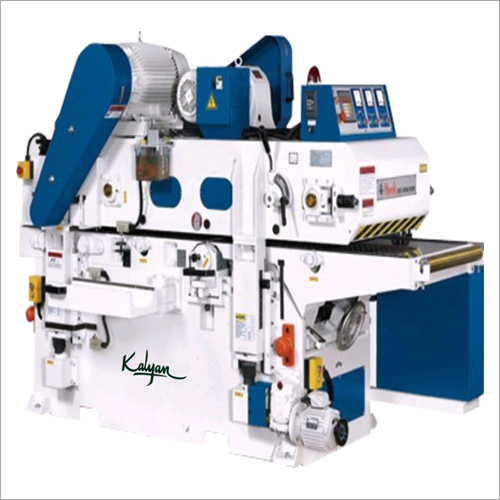
Double Side Planner
Product Details:
- Type Double Side Planner
- Material High Grade Cast Iron, Steel
- Capacity 1000 mm to 1500 mm planning width
- Computerized No
- Automatic Grade Semi-Automatic
- Power 7.5 HP to 10 HP
- Voltage 220V / 380V
- Click to View more
X
Double Side Planner Price And Quantity
- 1 Box
Double Side Planner Product Specifications
- 2300 x 1400 x 1500 mm
- Double Side Planner
- No
- 220V / 380V
- 7.5 HP to 10 HP
- Semi-Automatic
- Blue & Grey
- 1800 Kg (approx)
- 1000 mm to 1500 mm planning width
- High Grade Cast Iron, Steel
- Wood and Timber Surface Planing
- High Precision
- 8 mm to 150 mm
- Overload Protection, Emergency Stop
- Below 85 dB
- 4000 RPM
- Standard Reputed Brand
- 1500 mm
- 5-20 m/min (adjustable)
- 4
Double Side Planner Trade Information
- 100 Box Per Month
- 1 Months
Product Description

Specifications:
| MODEL | KI-REC-610AH |
| CAPACITY |
|
| Max. working width | 610 mm ( 24'') |
| Max. working thickness | 200 mm ( 8") |
| Min. working thickness | 8 mm |
| Min. working length | 315 mm (12 -1/2 ") |
| Table area | 686x2743 mm (27"x108") |
| TOOL SIZES |
|
| Knife sizes | 14x14x2.0 mm |
| Cutter head diameter | f 130 mm |
| Number of spiral knife | 6Tx150pcsx2sets |
| MOTOR HORSEPOWER |
|
| Cutter head speed | 6000 r.p.m. |
| Feed speed | 10~40 m/min |
| Top cutter head motor | 20 HP |
| Bottom cutter head motor | 15 HP |
| Feeding motor | 3 HP |
| Elevation motor | 1/2 HP |
| OTHERS |
|
| Air suction | 6" x 2 holes |
| Machine dim. (LxWxH) | 2910x1545x1720 mm |
| Packing dim. (LxWxH) | 2960x1700x1870 mm |
| Net weight (approx.) | 3100 kgs. |
| Gross weight (approx.) | 3800 kgs. |
All specifications, dimensions & design characteristic are subject to change without prior notice.
High-Precision Double Surface Planing
Experience exceptional surface finish with the advanced Double Side Planner designed for wood and timber processing. The robust construction, high-grade cast iron and steel materials, and precision engineering ensure consistent results for a wide variety of applications. Equipped with four knives and a high cutter speed, it guarantees smooth, uniform surfaces every time while keeping operational noise below 85 dB for a quieter work environment.
Versatility and Adjustable Performance
With an adjustable feed speed ranging from 5 to 20 meters per minute and a broad working thickness capability (8 mm to 150 mm), this machine adapts easily to varying material requirements. The planning width ranges from 1000 mm to 1500 mm, making it suitable for both small and large-scale woodworking operations. Efficient and reliable, it streamlines production workflows for manufacturers, exporters, and suppliers alike.
Safety and Reliability Built In
Operator protection is paramount in this double side planner. Features like overload protection and emergency stop mechanisms offer peace of mind, while the use of components from reputed brands ensures long-term reliability. The 7.5 to 10 HP main motor supports intensive use, and the sturdy build reduces vibration, resulting in cleaner finishes and enhanced safety during operation.
FAQs of Double Side Planner:
Q: How does the adjustable feed speed benefit workflow efficiency in this double side planner?
A: The adjustable feed speed, ranging from 5 to 20 meters per minute, allows operators to tailor the planning process to different types of wood and desired finishes. This flexibility enhances workflow by enabling faster processing for bulk jobs or slower, precision work for delicate materials.Q: What safety features are included in this machine to ensure user protection?
A: The double side planner is equipped with overload protection and an emergency stop function. These features help prevent equipment damage and safeguard operators from potential accidents during operation.Q: When is it best to use a double side planner in timber processing?
A: This machine is ideal for preparing timber surfaces before further machining, gluing, or assembly. It delivers a high-precision finish, making it suitable for use at the beginning or intermediate stages of timber product manufacturing.Q: Where can this double side planner be deployed effectively?
A: The machine is suitable for factories, workshops, and production facilities engaged in woodworking or timber processing. Its robust build and versatility make it valuable for exporters, manufacturers, suppliers, and traders within India and similar environments.Q: What is the typical process for using this double side planner?
A: Operators place the timber onto the 1500 mm table, adjust the feed speed and working thickness according to the material, and activate the planner. The four knives rotate at 4000 RPM, simultaneously planing both surfaces for a smooth, even result.Q: How does the high-precision surface finish benefit woodworking projects?
A: A high-precision finish reduces the need for additional sanding or reworking, saving time and preserving material integrity. It also ensures that subsequent processes, such as coating or joining, are more effective and yield better final product quality.Tell us about your requirement

Price:
Quantity
Select Unit
- 50
- 100
- 200
- 250
- 500
- 1000+
Additional detail
Mobile number
Email

Other Products in 'Plywood Making Machines' category


KALYAN INDUSTRIES
GST : 06AABFK0510G1Z2
GST : 06AABFK0510G1Z2

- Opposite Punjab & Sind Bank, Jagadhri Road,Yamunanagar - 135001, Haryana, India
- Phone :08045816035

- Mr Jagmohan Singh
- Mobile :08045816035
- Send Inquiry
 Send Inquiry
Our Products

|


 Send Inquiry
 Send SMS
 Call Me Free
Developed and Managed by Infocom Network Private Limited.

